AI has made it incredibly easy to create a shot.
Type a prompt. Generate an image. Animate it. Try another model. Change the prompt. Try again.
And again.
But somewhere along the way, we started confusing generating content with running a production.
A film is not a collection of prompts. An advertisement is not a pile of generated clips. A VFX shot is not simply an instruction sent to a model.
Production is about decisions.
What is the story? Who is the character? What does the world look like? What is the camera doing? What has already been approved? What changed? What does that change affect? How much will the next take cost? And, ultimately, who gets to say yes?
That is the problem Brahmāstra is built to solve.
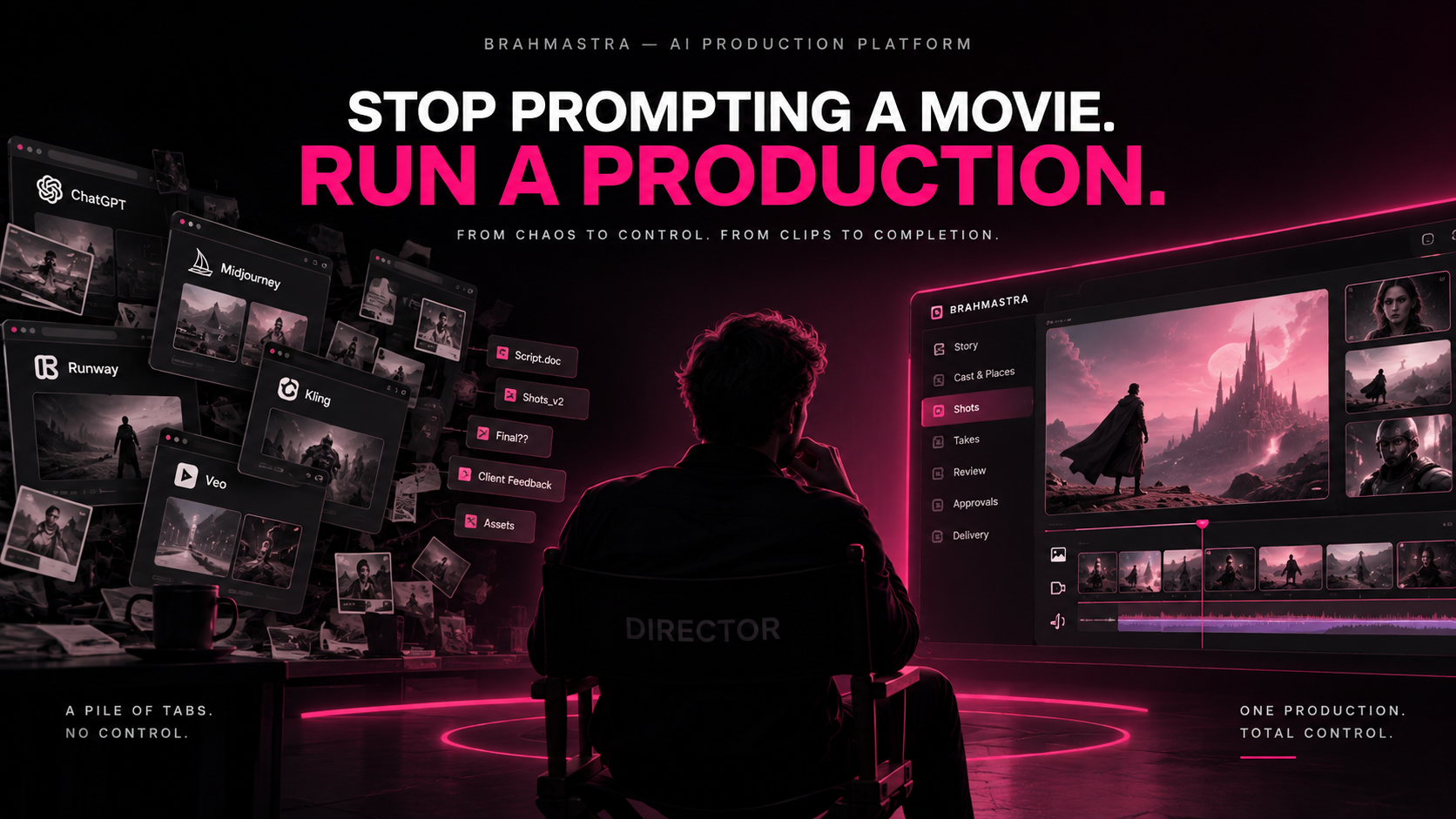
The AI "Pile of Tabs"
For most creators, AI filmmaking has become an exercise in managing chaos.
Your screenplay lives in one document.
Character references are somewhere in a cloud folder.
Your images are scattered across different tools.
Video generations are sitting in multiple accounts.
Production notes are buried in chats.
Approvals happen over messages.
And the actual creative decisions exist mostly inside someone's head.
You may have access to some of the most powerful generative models ever created, but your production itself has no source of truth.
That creates the same failures again and again.
The face does not stay the face
Shot 1 features your lead character.
Shot 2 features someone who looks vaguely similar.
By Shot 5, the character has a different age, different facial structure, different costume—and somehow the environment has changed too.
Credits disappear on "just try it"
You ask a model to make a video.
A job gets queued.
Then another.
Then another.
Eventually, you discover how much experimentation actually cost.
Iteration is necessary. Uncontrolled spending isn't.
Live action gets "helped"
You want to replace a dummy creature in a live-action plate.
Instead, the model changes your actor's face, clothing, lighting, or performance.
You asked for a VFX modification.
You got a new shot.
Products become fictional
An AI-generated advertisement can look beautiful while quietly inventing a package, changing a logo, altering a product feature, or creating a claim that the brand never made.
Visual quality isn't enough.
The product has to remain true.
Nothing is connected
You change a character.
You update a scene.
You revise a line in the screenplay.
But the system doesn't know which shots depend on that decision.
There is no concept of downstream impact.
No stale takes.
No production history.
Just more generations.
This is what happens when AI tools are optimized around prompts instead of productions.
The Shift: From Prompting to Production
We believe the next generation of AI filmmaking won't be defined by who writes the cleverest prompt.
It will be defined by who has the best production system.
That is the idea behind Brahmāstra.
We didn't build another chatbot. We built a production operating system.
Brahmāstra brings the creative process into one connected workspace where decisions, assets, generations, reviews, approvals, and delivery belong to the same production record.
Instead of:
prompt → generate → download → upload → repeat
the workflow becomes:
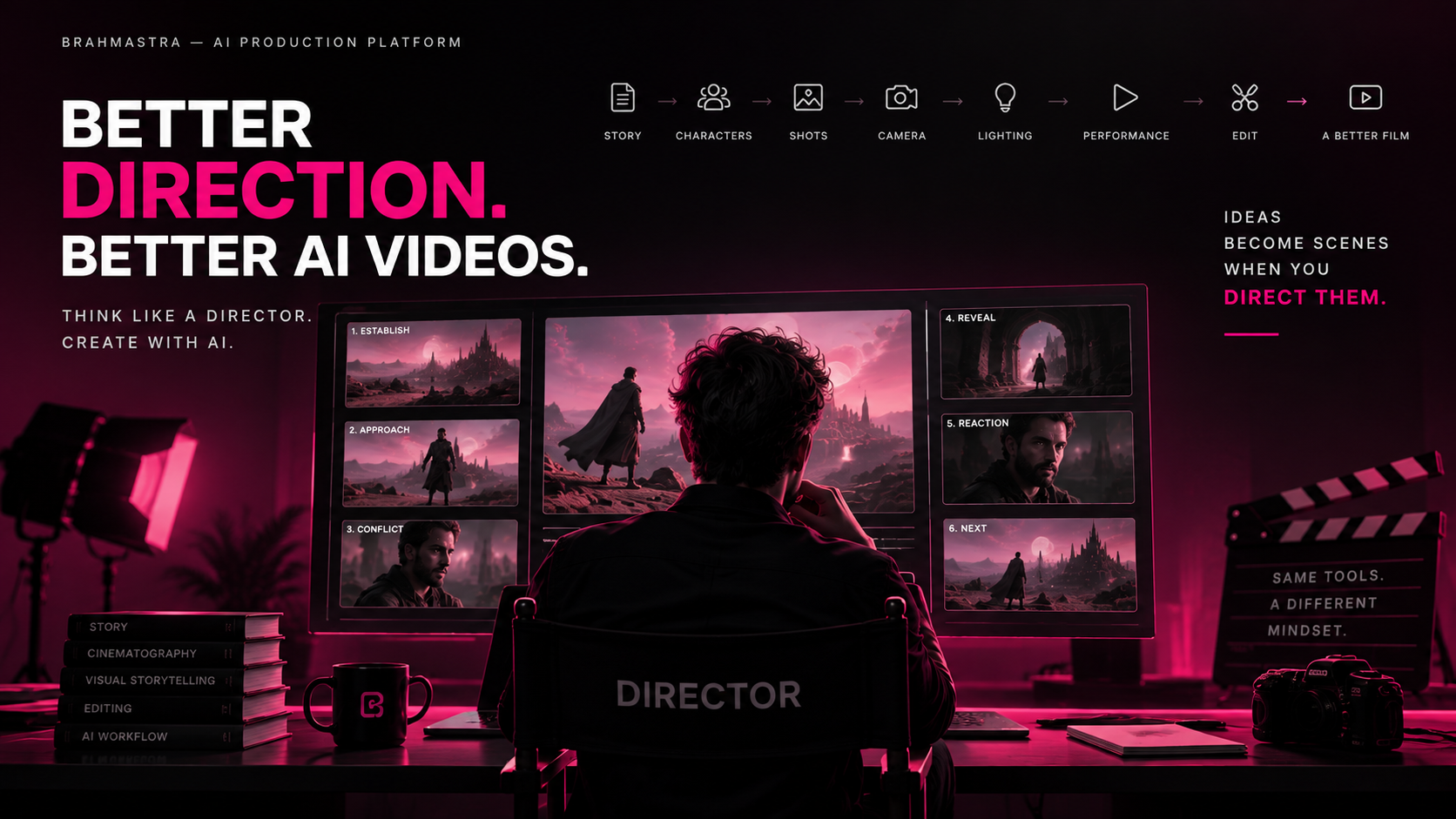
story → cast & places → shots → takes → review → approval → delivery
Every stage understands what came before it.
Every generation has context.
Every important decision can be locked.
And every take has a reason for existing.
Models Generate. You Lock.
AI models will keep changing.
Today's best video model may not be tomorrow's best video model.
New image models will arrive.
New audio models will arrive.
New video engines will become faster, cheaper, and more capable.
That's a good thing.
But your production shouldn't have to be rebuilt every time the model changes.
At Brahmāstra, we think of generative models as hired cameras.
You choose the right camera for the shot.
But the production record belongs to you.
Your characters.
Your environments.
Your approved references.
Your camera decisions.
Your takes.
Your reviews.
Your approvals.
Your final delivery.
The model is replaceable.
Your production intelligence is not.
Identity Locks: Decide What Must Not Change
Consistency is one of the biggest challenges in AI filmmaking.
A prompt can describe a character.
It doesn't necessarily guarantee that the character will remain the same.
That's why Brahmāstra treats identity as a production decision—not merely a prompt instruction.
Before shooting, characters can be established through canonical visual references and turnaround views.
Face.
Front.
Back.
Left.
Right.
These references become the visual foundation for the character.
Once an identity is locked, downstream generations are expected to respect it.
The same philosophy applies to environments and products.
Because when you say this is the character, this is the location, or this is the product, the production should know what you mean.
A Camera Console, Not a Prompt Box
Directors don't think exclusively in adjectives.
They think in lenses.
Angles.
Aperture.
Shutter.
Lighting.
Composition.
Movement.
Depth.
Intent.
Brahmāstra's Camera Console brings that language into AI production.
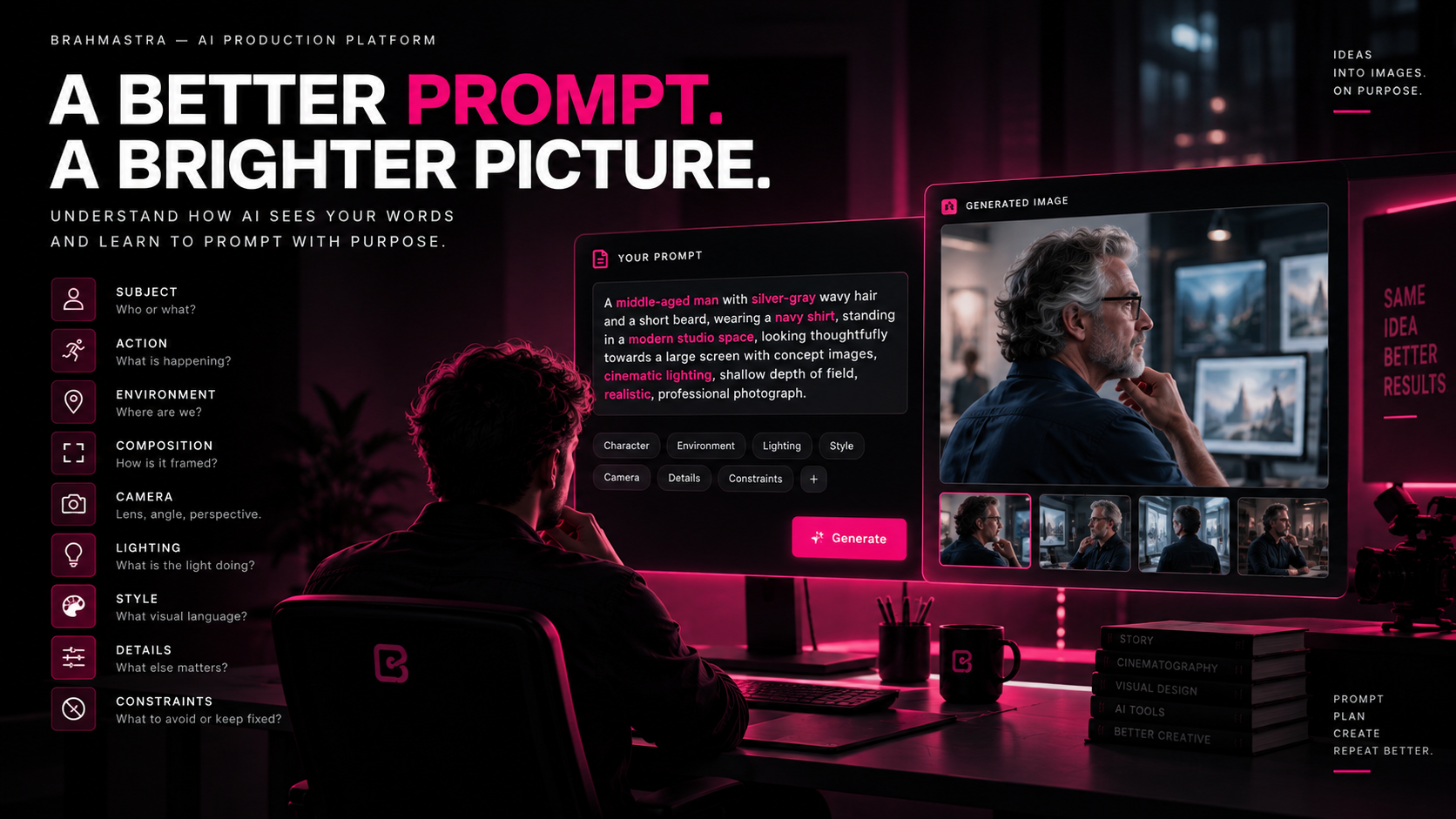
Instead of endlessly experimenting with vague instructions, creators can work with familiar cinematographic controls such as:
- Focal length
- Aperture
- Shutter speed
- Camera angle
- Camera movement
- Lighting
- Film characteristics
More importantly, Brahmāstra is designed around capability contracts.
If a selected generation engine cannot meaningfully support a particular control, the system shouldn't pretend that it can.
You shouldn't spend credits issuing commands that the engine simply ignores.
The interface should understand the camera you're hiring.
Six Ways Into a Production
Not every project needs the same workflow.
Sometimes you have a complete screenplay.
Sometimes you have one sentence.
Sometimes you have a live-action plate that needs VFX.
Sometimes you simply need one image.
Brahmāstra gives you different ways to enter the production while keeping the work connected.
Talk
You have an idea, not a production bible.
Start with a conversation.
Brahmāstra can turn that idea into a production plan without forcing you to build everything manually.
Film Studio
For multi-shot productions where continuity matters.
Build characters, worlds, shots, takes, reviews, and approvals through a structured production pipeline.
AI-Aided VFX
Work with live-action plates while protecting the parts of the image that matter.
Modify what needs to change.
Protect what must remain untouched.
Compare the original and result through frame-accurate A/B review.
Marketing Studio
Create advertising content from approved product truth.
The goal isn't simply to make an attractive advertisement.
It's to make an advertisement that remains faithful to the product.
Instant Generator
Sometimes you don't need a production pipeline.
You just need a shot.
Generate a still or clip quickly without unnecessary ceremony.
Upscale
Take an approved master and improve its resolution or clarity without rebuilding the creative decision from scratch.
Different doors.
One production record.
Production Should Know What It Costs
Creative experimentation is essential.
Surprise invoices are not.
Brahmāstra is designed around cost visibility.
Before a billable generation happens, the production can surface the expected spend through a Confirm Spend step.
You know what you're about to use.
You know what you're about to spend.
Then you decide whether that take is worth it.
This changes the psychology of AI production.
Instead of blindly burning credits while searching for something good, you can treat expensive generations like real production decisions.
Plan first. Spend intentionally.
Keep the Crew Room Local
Not every production task needs an expensive generation model.
Story development.
Brainstorming.
Research.
Planning.
Supervision.
Internal iteration.
These are often tasks that can be handled without consuming your premium generation credits.
Brahmāstra can connect with local AI infrastructure, including Ollama, allowing teams to run parts of their production workflow on their own hardware.
The expensive cameras should be reserved for the shots that actually need them.
Review Like a Production, Not a Chat
Eventually, the work leaves the creator's screen.
A client needs to see it.
A producer needs to review it.
A brand needs to approve it.
A director needs to make a decision.
That's why Brahmāstra includes External Director Review.
Instead of asking a client to create another account and navigate your entire workspace, you can provide an expiring, revocable review link.
They can review.
Annotate.
Comment.
Approve.
And the production retains the context.
Because review shouldn't create another disconnected communication channel.
It should become part of the production record.
The Real Product Isn't the Model
Generative AI is moving too quickly for any single model to be the foundation of your production company.
Models will change.
Providers will change.
Prices will change.
Capabilities will change.
Your production shouldn't have to.
The durable asset is everything surrounding the generation:
the decisions, the references, the relationships between them, the history, the approvals, and the final creative intent.
That's what Brahmāstra is designed to preserve.
The Director Still Runs the Show
AI doesn't need another interface that pretends the machine knows what the filmmaker wants.
The director should remain in control.
The human decides the story.
The human locks the identity.
The human chooses the shot.
The human controls the budget.
The human reviews the result.
The human approves the final frame.
Brahmāstra provides the instruments, the connected workflow, and the AI crew.
You provide the vision.
The future of AI filmmaking isn't about generating more clips.
It's about making better decisions, keeping those decisions connected, and turning them into work that can actually ship.
So stop prompting a movie.
Run a production.
Welcome to Brahmāstra.